𝖏𝖔𝖚𝖗𝖓𝖆𝖑
26.03.26 – witnessed
I don’t have a therapist. I have a Master of Psychology student who is under the direct supervision of a licensed psychologist, and we call it therapy. I go to the local university in a room right next to the classrooms, where I pay $20 a visit and can run up a small tab without it being a ruckus.
My assigned student is not particularly helpful – but then again, none of my other, real therapists have been either. I just need a place where I can talk. On this day, I’m in an abysmal mood. I’m lamenting about my deeper complexes, lamenting about how stuck I feel, alien I feel, how exhausting it is to participate in what feels like one giant puppet show. I get irritated with her because I can tell she doesn’t know what to say. She is phrasing her own thoughts like open-ended questions intended to railroad me into one answer. I do the exact same thing when I’m at a loss for words in my own sessions. I resist the urge to critique her for this reason. Instead, I glare at her relentlessly while giving short answers. I find myself trying to see if I can make her break her gaze. I become tired of answering questions and we end early.
Instead of exiting the building streetside, I choose to exit campus side – an impulsive and anomalous move. Almost immediately, a weeping cherry tree catches my eye, and I cannot resist its blooms. I stand under it for a little bit, watching the bees, seeking the stillness inside, my one respite.
“Do you like my tree?”
I look down. There’s an older woman watching me from a nearby doorway.
“Is this your tree?” I don’t remember her response, but we start talking about what kind of tree it is.
Eventually, she asks: “Have you been inside the greenhouse?”
“No.”
“You wanna come see?”
“Yeah.”
She introduces herself as Vickie the Lead Gardener. “I say I’m lead gardener because I’m the only one here. Hah!” She’s small and has a grounded vigor about her. She gives me a tour of the greenhouse, tells me what each room is for and where the plants go. The older plants have names and many offspring that are sold to raise money. The greenhouse collects waste and repurposes it. They make their own soil now because of how expensive their premix has gotten. She tells me all this, and I fight to stay focused in the immense heat and social anxiety and concern about my short time window. I am just happy that someone noticed me and took the time to share something they like and knew I would too. Vickie invites me back any time. I think I’ll take her my struggling aloe plant. It will have a better home there.
26.03.12 – passing by
I run to the nearby supermarket to grab a couple things: nitrile gloves for the dish bleach water, isopropyl alcohol and cotton swabs for my T shots, multigrain bread for my newfound intolerance for enriched white breads, cat food, some “buffalo style chicken dip” for the leftover corn chips. A tank of gas for the first time since we, yes, started bombing Iran. The little errand feels absurd. People bumping around clumsily in their gigantic cars feels absurd.
On the way back, I pass by a haunted bowling alley, years abandoned and strung with signs of promised construction that never came. A mom and her teenage kids are standing in its desolate parking lot with a few shopping carts threaded with t-shirts. A woman in an SUV is hanging out her driver side window and is exchanging cash with the mom.
26.03.08 – a lesson in parallels
A knock on the door after nightfall. My husband gets it, and after a moment, I hear him say, “There’s a dead cat under our porch?” At this point, I get up off the couch.
It’s our neighbor. He relays that sometime in the late afternoon, two loose dogs came through the neighborhood and went rampaging on the stray and outdoor cats that live on our street. A lot of them were his and his grandpa’s, who just went to the hospital after a fall. Somehow, one got in behind our fence and died under our back porch and wanted to let us know he’d be around taking care of it.
He didn’t ask for help, but my husband and I got our nylon gloves and some trash bags. I could tell after a moment they were both hesitant to crawl under. “So, how do we do this?” I mean, you just --- get on your hands and knees and crawl. I pressed in with my boxers hanging out my pants and got mud on my knees and found the cat – grey and white medium length fur - in full rigor mortis tangled up in some English ivy. I’d never felt rigor mortis like that before. He was stiff as a tray, but I got him bagged up.
We followed the neighbor down the road to the other two cats, who had passed in someone’s front yard. Someone came through earlier and covered them with black fabric and pinned the fabric down with pieces of scrap wood, I’m guessing to keep the flies off. The next one was completely black. I knew this one; I called him Grumpus. He was battle worn and untrustworthy and always had a wound and I loved him for it. He finally met his end. We packed him up easily.
“Get ready, this one’s bad,” my neighbor said and he lifted the fabric. Tortoiseshell cat with her entrails ripped out. She was pregnant. “They got her jaw too?!” I told the neighbor he should step back. My husband and I handled that one. We got the whole cat in the bag (heh), but some intestines were hanging out. They flipped into the bag on their own, flinging some “cat juice” on my husband’s face.
By the time we were done, there were four makeshift body bags lined up on our neighbor's porch. My neighbor was not sure where to bury them all; they didn’t have the space. I recommended the abandoned railroad property nearby. He also sought advice on whether he should show the other cat, who had been acting uneasy since everything went down. I told him he should. Otherwise, it would remain confused without closure. As my husband and I walked home, I heard my neighbor calling for the remaining cat so he could show him what happened to his friend. I knew that’d be hard.
My neighbor loved those cats, and dogs came through and killed them for sport. I can’t help but to think about Iran and Gaza. Two mean dogs fly through the area, killing for sport, and are already gone by the time people emerge to clean up the mess. I wonder how much harder it is to untangle people in full rigor mortis from the heavy rubble of buildings. I imagine people taking inventory of the corpses as they piece together their identities. “Oh, this is Ahmed.” I feel powerless against these deranged Christonationalists who are killing for sport, LARPing their dumbass holy war. There is no uplifting message here -- just a lesson in parallels.
26.02.25 – restless
I enter the coffee shop and ask for an ice water. As I do, I feel an intense gaze upon me. I am standing in the direct line of sight of an older man sitting nearby. He's dressed well. I'm dressed down in a strange kind of way -- almost like intentional pajamas. I wasn't expecting to come here, and now I am acutely aware of the insecurity I feel at the possibility of being judged by this man who is dressed nicely in his beret and knitted vest and soft pink button down.
I make eye contact with him in the sitting area the same way a dog makes eye contact to appear unafraid. I sit at a high top facing a big window, where I can watch the buoyant, flittering snow. I am behind the man now, who is speaking to his company in a language I don't understand. It sounds Hebrew. Eventually, they fall back into English. "Hosanna. It means 'glory to God.'" They talk about forming a Hebrew study group before lapsing into a conversatiom about the differences between Reform, Conservative, and Orthodox. The nicely dressed man is a rabbi, and I remember I tried to speak to him at an event once, and he was not open to conversing for whatever reason, and that stuck with me. I know this because we have only one rabbi in town.
I sip my water, glancing at the door occasionally to see if my own company has arrived yet. Eventually they do. They have a lot of exciting things happening in their life, mainly around travel. They see many places and will move out of this area in pursuit of academic study soon. It hits a sore spot, that part of me that impatiently gnashes and gnaws over my own lack of exposure to the world, the part of me that wakes up every day and looks at dilapidated infrastructure and coagulated heaps of trash on the streets and monoculture at every turn and laments that this is where I spend my waking days. I notice this though, which is nice, because I separate myself from it and can share their excitement and acknowledge the work they have done to earn this opportunity.
I also notice their demeanor shift when I start talking about my life, the enthusiasm fade, a courteous engagement of one or two follow up questions before shifting back to their own affairs. I keep it short for their sake. Another sore spot, but fall into my behavioral health skills to keep pace with this.
I do emerge from this experience with a renewed sense of autonomy and motivation to more enthusiastically pursue my aspirations. I still wait around for other people to care, to get the green light to do things. I still catch myself grieving over having wasted much time in the throes of codependency and trauma. All of these I am convinced I am past, but little moments of clarity often surprise us.
With this, it is equally necessary to cultivate a sense of gratitude and understanding, as the best balance is to acknowledge your progress and the full spectrum of your current situation while working towards your aspirations. Otherwise it becomes a hedonic treadmill. If I had already gotten the things I yearn for, I would have probably taken them for granted. I need to learn to live well and be adaptable and present in conditions which are not ideal. Change needs to be rooted in curiosity and growth and not running from the unpleasant. For that reason, I have a reason to be glad I have spent so long in one place. Only by planting my feet have I been able to begin cornering my unhealthy coping mechanisms.
All too often I forget gratitude . Brains are wired to see threats and ugliness and my neural pathways are well worn for it. However, the Dao flows like water to the bottom, trash heaps be damned.
26.02.21 – benign encounter
We're sitting on the doorstep of a nondescript cinderblock building painted baby blue. A sign on the door says "Out to Lunch, 12:30-1:30" in cursive font. It is a false spring day, and the sun saturates our eyes as we watch freeway cars speed past in front of hills jagged with barren trees. The door opens quietly behind us and a waves us in before disappearing inside. The room is simple, bright, clean, and smells like cigarettes. When we make it to her desk, I see fingertips with bright red nail polish beckoning me to provide my documents. Her hair is a silky silver, her shirt baby blue too, and her name is Rita. You can tell quickly she is a hardened Appalachian woman, but not without a sense of humor to match.
26.02.07 – stained
I get home from the book store and immediately pry open the book on Buddhism I got used for $3.98. It's a deal, and I understand why. When I lean in to smell it, I find the faintest smell of cigarettes baked into the pages. I wonder who had this book last - I picture them searching for an alleviation to the suffering that caused them to seek regulation through nicotine, flipping pages while a Marlboro burns idly, balanced between two fingers. Did they finish it? In their parting with this book, did they forsake the dharma, lovingly hope that someone else will benefit from it too, or feel neutral indifference? Did they ever feel empowered and content enough to quit smoking?
26.02.04 – untitled
Season of bones -- oak and stone
Traveler alone on streets forsaken --
A laden silhouette, warmed by domestic esprit
and black as iron amongst the snow.
Run home, Traveler; follow the hearth's glow.
Pitiless is Father Winter, who takes --
even from those who venture out to marvel at his wake.
Count your blessings until the earth rouses below.
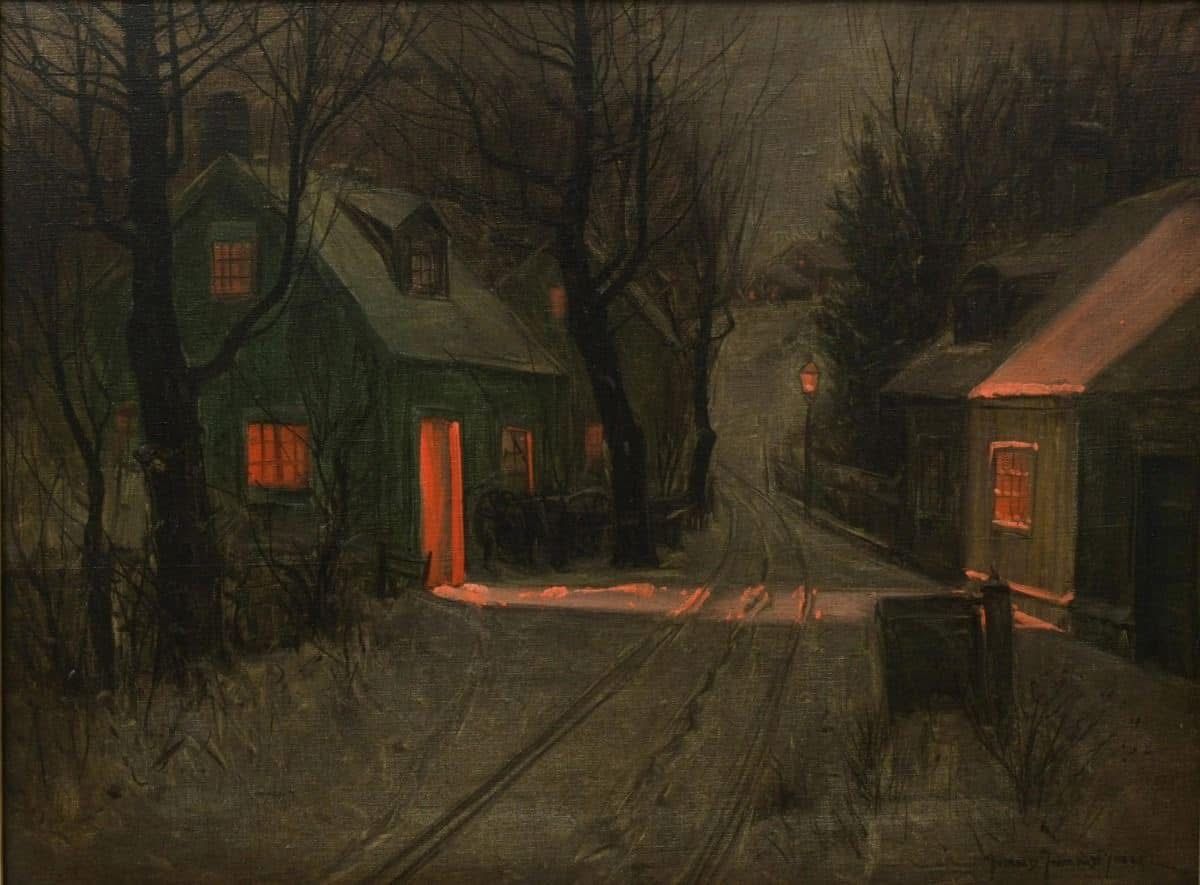
Winter's Nihght by Svend Rasmussen Svendsen (1910)
26.02.03 – on teegarden
Teegarden’s Star is “an M-type red dwarf 12.5 light years away from the Solar System.” Teegarden’s Star b is an exoplanet found within the habitable zone of Teegarden’s Star and “has the highest Earth Similarity Index of any exoplanet found to-date. Along with Teegarden's Star c, it is among the closest known potentially habitable exoplanets.”
If we could just start all over on a new world, shedding our conditioning, our preconceptions, our histories in the process, what would happen? What would we do? Could we be better this time? It easily becomes an inquiry about the natural disposition of humanity, but that is not the purpose Teegarden's Star b serves for me. It is a loving memorial of what never was, and maybe what never can be: a compassionate, egalitarian, post-scarcity society where we live in awe and respect of our environment and our shared divinity.

Stellar Radiance by David Hardy (1969)
26.02.02 - on music streaming
I purchased a cheap little music player off jeffbezos.com last fall after growing exasperated with Spotify. I think it was some sort of generalized rebuke after some sort of final straw -- ICE recruitment ads, I believe. I’m not here to talk about that though. I ended up getting this music player over it, and that’s what I’m here to talk about.
I quickly realized that streaming music for the last 13 years has left me complacent and bloated with what marketing people call decision fatigue. I can listen to anything I want at any time. I can look up, I don’t know, “hyper alt glitchcore” and something will almost certainly be regurgitated back to me. I can click next next next next through gigs of flac files until I find something that perfectly satisfies the increasingly niche mood. It gets to the point where I don’t even know what I’m looking for anymore, becoming an existential matter for me, but again, not the point.
You can’t do that with a music player!
Do you people who are, like, 27 and older remember slogging through a Youtube to mp3 ripping session and manually adding all the title information to the metadata on your iTunes? It was a process. Still is. The time commitment for each track demands that you pick your music with intention. That poses the question: what kind of music needs to be with you on the go, and what can stay home? I like the constraints this puts on me. Gets me out of my slovenly dissociation to appreciate the music more.
Check out SpotiFLAC on GitHub. You can download files right off Spotify onto your local device. I am not going to tell you to steal from Spotify, but I am not going to stop you either.
26.02.01 - on human resilience and imbolc
The World Keeps Ending and the World Goes On - Franny Choi
Presented by our lead minister during service this morning. I grew up not happy, but privileged nonetheless. I was taught that the greatest defilements belonged to the past and that we had learned from them. I knew bad things still happen, but I didn't know how palpable it continues to be and how compromised we still are. This is not a unique story, but this is my page, so I will reflect on it as I please.
It took a long while for me to accept and internalize that the terrible is just as integral to our universe as the beautiful. But I think I'm here now. Not that I am happy about it, but there is a certain steadfastness and resilience that comes with alignment. I can watch a video of a Palestinean getting their head blown off without crumbling. I can hear about the ICE raids in my neighborhood without resigning to agoraphobia. I can look at these things and let them create urgency to keep moving - as long as I stay balanced overall. I wish I could remember the 'Buddhist activist' with a podcast that taught me the phrase 'accept without condoning,' as it has become a mantra to me. In the spirit of Choi's poem, too, it has helped to know this just has been how things always are. We are not special. Just as spiritual sickness swells naturally, so does the sense of duty to repel it. These are the ancestors we can call upon to guide us.
Still, it is hard to keep the balance that allows me to gaze into the sickness. This winter has been hard. The Imbolc gatherings this weekend, thankfully, have been healing to myself and others. I knowingly conversed with Brigid for the first time at the nexus of her ritual space. Humbled and grateful, I felt a warm flame melt the ice that had accumulated within me. I was able to cry for the first time in a while.
Cleaned house for Imbolc practice as well. Got the holiday tree taken down and offered the house spirits the last two saltwater taffies from my trip to St. Augustine last Thanksgiving. I found a point-and-shoot camera my husband got for his birthday long ago and has yet to use. I think I will help myself to it. I have been slowly pulling away from my phone. First, from music streaming to music player. Why not photos too?

The Coming of Bríde by John Duncan (1917)